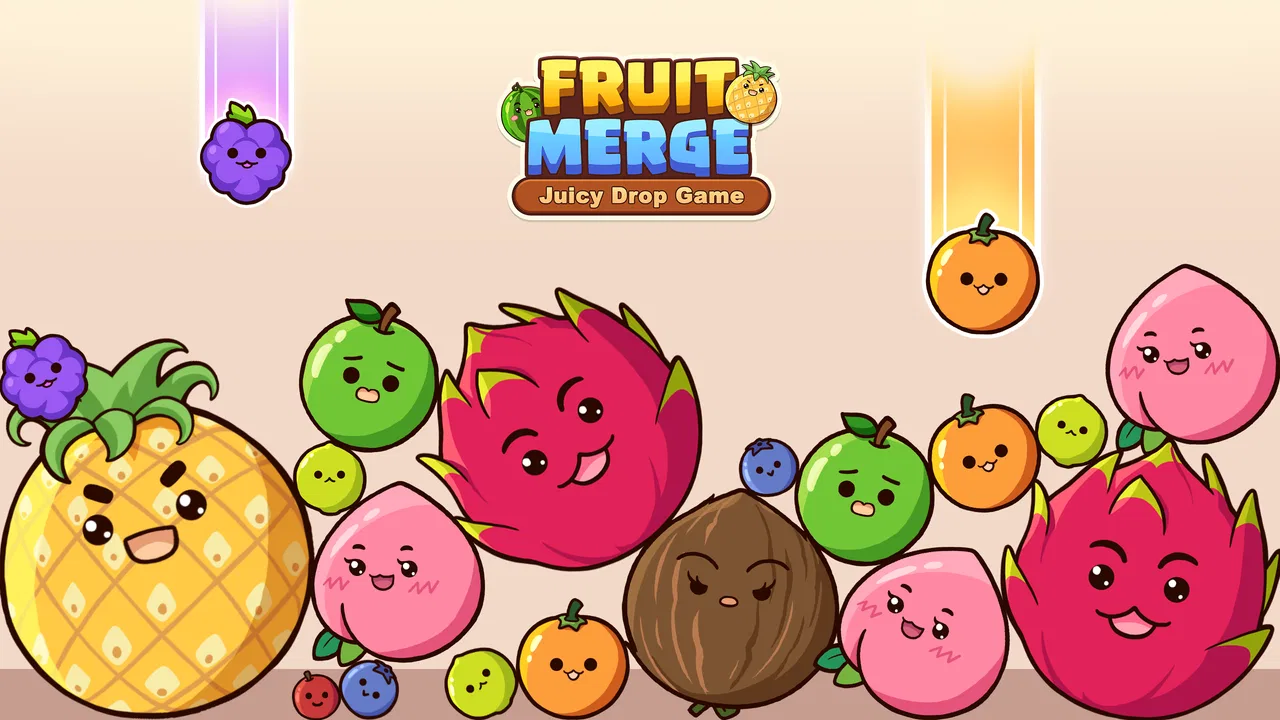
Fruit Merge™: Match Game
- 4.4
- Rating
- 50.00M
- Installs
- Free
- Price

 Analysis by App-foxy
I went into Fruit Merge™ expecting a simple way to fill a few spare minutes, and that is exactly where this puzzle game works best. Its central idea is easy to understand: place matching fruits together and merge them into larger ones. The appeal comes from deciding where each piece should go before the board becomes awkward to manage. It is not a story-driven adventure or a demanding brain-training program. It is a compact, repeatable puzzle built around planning, patience, and the small satisfaction of turning several modest pieces into one impressive result.
My overall view is positive, with an important qualification: this is best enjoyed as a relaxed casual game rather than as a deep strategy experience. The free entry point makes it easy to try, and the Everyone age rating gives it a broad audience. At the same time, players who need constant variety, competitive depth, or a clearly finished campaign may find the basic merge loop too familiar after extended sessions.
Why the merge loop is more thoughtful than it first appears
The first few rounds feel almost effortless. I could look at the available fruit, identify an obvious match, and make a move without much preparation. That simplicity is useful because it lets a new player understand the rules immediately. There is no long explanation to work through before the puzzle becomes playable, and the fruit theme keeps the board approachable rather than intimidating.
You May Also Like

 Blood Strike: 2.5 Anniversary
Blood Strike’s Loadouts Turn Every Drop Into a Tactical Gamble
A close look at Blood Strike’s custom loadouts: how fast access to signature weapons reshapes its battle royale rhythm, rewards preparation, and narrows the gap between fights.

 Pandora - Music & Podcasts
Pandora’s Music Is Easy to Start, but Harder to Recover
Pandora’s strength is its low-effort path from a seed to a station. Its weak spot is how much confidence it asks you to place in connection, setup, and quiet recovery.

 8 Ball Pool
 Is Built on Rivalries, Rematches, and Routine
A close look at the rivalries, rematches, shared routines, and unanswered safety questions that turn a quick pool match into a persistent mobile community.

 Samsung Music
’s Quiet Strength Is Playing What You Already Own
Its reach comes less from spectacle than from dependable access to a personal library. That simplicity is both the app’s strongest retention engine and its ceiling.

 AccuWeather: Weather Radar
AccuWeather Review: A Quick, Clear Forecast for Everyday Decisions
For everyday plans, the best forecast is the one you can understand quickly. AccuWeather makes rain timing, radar, and local conditions easy to act on, with a few trade-offs.

 Hill Climb Racing
Why Hill Climb Racing Still Turns Crashes Into One More Run
A tiny car, a bumpy hill and one more upgrade: Hill Climb Racing keeps resurfacing because its simple chaos makes every near-miss feel personal.
More From Our News Desk
View All News


The interesting part begins when I stop treating every match as an isolated opportunity. A move can solve a small problem while creating a larger one. If I merge pieces too quickly in the wrong area, I may leave an awkward gap or push larger fruit into positions that make later combinations harder. The best decisions are often about preserving room for future moves rather than chasing the most obvious match on the screen.
That gives the game a pleasant rhythm. I make a move, watch the board change, and then reassess instead of following a fixed sequence. The result is more engaging than a purely automatic matching game, even though the rules remain accessible. The real skill is space management, not fast tapping. I found that especially useful when I wanted something calming but still wanted my choices to matter.
One practical habit improved my sessions immediately: I started looking at the whole board before placing a fruit. It is tempting to focus on the nearest pair, but a quick scan can reveal a safer location for the next piece. I also became more careful about building a tall or crowded section on one side. Keeping the board visually open gives later merges more options and reduces the feeling that a single poor placement has ruined the round.
Another useful approach is to delay a merge when the resulting larger fruit would block a valuable area. A match is not automatically a good move if it leaves the board less flexible. This is a subtle trade-off, and it is one reason the game can hold attention beyond the first few minutes. The rules are simple, but the consequences of placement are not always immediate.
A good fit for short breaks and low-pressure play
I can easily imagine opening this during a coffee break, while waiting for an appointment, or at the end of the day when I want a game that does not demand a long commitment. The individual decisions are small enough to make the experience approachable, yet the board still gives me something to think about. It does not require the concentration of a complex logic puzzle, so I can play casually without feeling that I need a completely quiet room.
That convenience is also why it works well for people who are new to puzzle games. Someone who finds traditional match-three games repetitive or timed puzzle titles stressful may appreciate the gentler pace here. The fruit presentation makes the activity feel friendly, and the basic objective can be understood without gaming experience.
However, I would not describe it as completely mindless. A player who rushes every placement may reach a crowded position quickly. The game rewards a little restraint, especially when deciding whether to create a larger fruit now or preserve smaller pieces for a more useful chain later. That balance between relaxation and light planning is the strongest part of the experience.
What the player numbers suggest, and what they do not guarantee
The game has reached more than 10 million installs, and its average rating is 4.4 from roughly 252 thousand ratings. Those figures indicate that the format has found a large audience, and my own experience makes that understandable: the controls are approachable, the objective is instantly clear, and a short session can still feel satisfying.
Popularity should not be confused with unlimited depth, though. A large audience may enjoy the convenience of a familiar casual loop without expecting the complexity found in a dedicated strategy title. I would read the strong reception as evidence that the basic formula is appealing, not as a promise that every player will remain interested for weeks.
Where the game earns its place among casual puzzle alternatives
Compared with a conventional match-three game, Fruit Merge™ places more emphasis on positioning and accumulation than on clearing a grid through rapid combinations. In a typical match-three title, I often look for patterns that disappear immediately and may be supported by goals, special pieces, or timed challenges. Here, the pleasure comes from watching the board develop and deciding how to make the next merge without losing control of the available space.
That difference makes it a better choice for someone who dislikes countdowns or constant visual pressure. I can think through a placement instead of racing a clock. It also makes the game less suitable for players who want dramatic chain reactions every few seconds. The satisfaction is quieter and more deliberate.
It also differs from traditional number-merging puzzles. Those games often present a very abstract board where every tile represents a value. The fruit theme makes the progression easier to read at a glance. I can recognize the pieces quickly and understand the goal visually, which helps the game feel lighter than a purely mathematical version of the same general idea.
On the other hand, players who prefer word puzzles, deduction grids, or carefully designed one-time challenges may find the repeating merge structure less rewarding. Those alternatives often provide a wider range of problem types. This game concentrates on one mechanic and asks whether that mechanic remains enjoyable through repetition.
That focus is both its strength and its limitation. Because the rules stay consistent, I can settle into a comfortable routine. Because the rules stay consistent, I may also want another game nearby when I am looking for a fresh challenge. I would choose this title for dependable short sessions, not as my only puzzle game.
Small decisions that make a noticeable difference
The most useful strategy is to treat open space as a resource. When I had several possible placements, I preferred the one that kept the center and upper areas less congested. This gave me more room to respond when the next fruit did not fit my preferred plan. It is easy to underestimate how valuable flexibility is until the board starts filling up.
I also found it helpful to avoid creating a single oversized stack too early. Larger fruit can be satisfying to produce, but placing one without considering its surroundings may divide the board into inconvenient pockets. A slower sequence of smaller merges can sometimes leave a healthier layout than one impressive combination.
A third tip is to use a pause in decision-making as part of the strategy. I did not need to place the next fruit instantly. Taking a moment to compare two or three possible locations often prevented an impulsive move. This is particularly useful for younger players, because it turns the game into a gentle lesson in planning without making the experience feel educational or formal.
These observations are not complicated tricks, but they change how the game feels. At first, I was merely matching fruit. Later, I was managing future options. That shift is where the title becomes more than a decorative tapping exercise.
The meaningful limitations I noticed during longer sessions
The biggest weakness is repetition. The central mechanic is pleasant, but it remains the central mechanic. After I had played several rounds, the novelty of combining fruit was naturally lower. The game can still be enjoyable in short bursts, yet I would be cautious about recommending it to someone who expects a large campaign, a wide collection of puzzle formats, or a steadily expanding set of rules.
Its free price makes trying it simple, but free casual games can also create a different kind of friction. The title includes in-app purchases ranging from $1.99 to $23.99 per item. I would approach those purchases carefully and decide in advance whether I am comfortable spending money inside a game whose main loop is intentionally repetitive. A player who wants a completely purchase-free experience should pay attention to how the game fits their own habits and budget before committing to long sessions.
I also think the game is more enjoyable when treated as a self-contained pastime rather than a competitive achievement project. If I compare every result with other players or expect constant progression, the limited scope becomes more noticeable. The design is strongest when I focus on making a good board and improving my own decisions, not when I demand the structure of a larger competitive puzzle platform.
Another limitation is that the accessible design may feel too gentle for experienced puzzle fans. Players who enjoy difficult deduction problems, strict move limits, or elaborate multi-stage objectives may want something with more pressure. Fruit Merge™ offers a softer kind of challenge, based on avoiding bad positions and maintaining options. That is a legitimate style, but it will not satisfy every definition of “challenging.”
The current version is 2.50, and the game supports devices running Android 7.0 or later. For someone using an older device, that operating-system requirement is worth checking before attempting an installation. For most compatible users, the more important question is not hardware power but whether the simple merge structure matches their preferred way to relax.
Who should play it, and who should skip it
I would recommend it to casual puzzle players who enjoy gradual progress, visual combinations, and decisions that can be made in seconds. It is especially suitable for someone who wants a friendly game to revisit rather than a title that requires learning a complicated system. Families may also find the Everyone rating reassuring, although younger players may still benefit from guidance around in-app purchases.
It is a sensible choice for players who like to improve through small adjustments. If you enjoy noticing that a better arrangement gives you more room several moves later, you will probably find enough satisfaction here. The game rewards attention without demanding expert knowledge, and that makes it approachable for a broad range of ages.
I would skip it if my priority were a rich narrative, a large variety of modes, or a puzzle experience that constantly introduces new mechanics. I would also look elsewhere if I knew I was vulnerable to spending impulsively in free games. The purchase range is clear enough to consider before playing, and a calm merge game is not worth turning into an uncomfortable expense.
For a realistic everyday example, I could recommend it to a commuter who has ten quiet minutes before reaching a destination. That player can complete a few thoughtful moves, stop without losing the basic appeal, and return later with a fresh view of the board. I would not recommend it as the main entertainment for a long flight unless the person already knows that repeating one mechanic is enough to keep them engaged.
The developer, Brave HK Limited, has kept the concept focused rather than overcomplicating its first impression. That focus helps a new player begin quickly, but it also means the game has to rely on the strength of its merge loop. In my experience, that loop is good enough for regular short visits, though not so broad that it replaces every other puzzle option.
My final recommendation
Fruit Merge™: Match Game is a pleasant, approachable puzzle for players who enjoy arranging pieces, protecting open space, and building toward larger combinations. I like that it gives simple actions a little strategic weight. The best moments come when I resist an obvious merge, preserve room, and later turn that patience into a more useful sequence.
Its weaknesses are equally clear. The format can become repetitive, the challenge is intentionally moderate, and the presence of in-app purchases means I would play with a sensible spending limit. Those are not deal-breakers for me, but they matter when deciding whether this should be a quick break-time game or a long-term favorite.
As a free game for Everyone, it is easy to try, and the broad response from players supports its appeal. I would recommend it to anyone who wants a low-pressure fruit-themed puzzle with enough planning to prevent it from feeling entirely automatic. Choose it for calm, bite-sized strategy; choose another puzzle game when you need variety, competition, or deeper difficulty.
My verdict is that it earns a place on an Android device for casual players who enjoy the merge formula. I would keep sessions short, protect the open areas of the board, and judge success by the quality of my decisions rather than by rushing toward the biggest fruit. Used that way, it delivers exactly the kind of light but thoughtful entertainment I wanted from it.
FAQs for Fruit Merge™: Match Game
01What is the main objective of Fruit Merge™: Match Game?
Fruit Merge™: Match Game challenges players to combine and match various fruits to create higher-level items. The primary goal is to strategically merge fruits to clear levels, earn points, and unlock new stages. As you progress, the puzzles become more complex, requiring thoughtful planning and quick reflexes.
02Is Fruit Merge™: Match Game free to play?
Yes, Fruit Merge™: Match Game is free to download and play. However, it offers in-app purchases that can enhance the gaming experience. These may include additional lives, power-ups, or ad-free gameplay. Players can enjoy the core game without spending money, but optional purchases can provide advantages.
03What are the system requirements for Fruit Merge™: Match Game?
Fruit Merge™: Match Game is designed to run smoothly on most modern Android and iOS devices. It requires Android version 5.0 and up or iOS 10.0 or later. Ensure your device has adequate storage space and is updated to the latest software version for optimal performance.
04Can I play Fruit Merge™: Match Game offline?
Fruit Merge™: Match Game offers offline play functionality, allowing you to enjoy the game without an internet connection. However, certain features like in-app purchases, leaderboards, and social interactions require an internet connection to access. Offline play is perfect for enjoying the game on the go.
05Does Fruit Merge™: Match Game include any social features?
Yes, Fruit Merge™: Match Game includes several social features. Players can connect their game to social media accounts to compete with friends on leaderboards, share achievements, and send or receive in-game gifts. These features enhance the competitive aspect and make the game more engaging.
Pros
- Engaging and colorful graphics.
- Simple and intuitive controls.
- Variety of challenging levels.
- Regular updates with new content.
- Offline play available.
Cons
- Ads can be intrusive.
- Limited lives may frustrate players.
- In-app purchases are pricey.
- Requires frequent updates.
- Can be repetitive over time.

Fruit Merge™: Match Game
Gallery